Crafted in the Emirates: Why America's Most Discerning Collectors Are Commissioning the World's Next Great Luxury Provenance

For the better part of a century, provenance in luxury was a European affair. A handbag stitched in Florence. A timepiece assembled in Geneva. A couture gown finished in a Parisian atelier. The geography of excellence was, by consensus, settled. Then came a generation of American collectors who decided that consensus was simply another word for limitation.
Today, a quietly influential cohort of ultra-high-net-worth Americans is redirecting its patronage toward the UAE — not because it is fashionable, and certainly not because it is convenient, but because the Emirates have become one of the few places on earth where creative ambition operates entirely without a ceiling.
The Problem With Inherited Prestige
There is a particular kind of fatigue that sets in among serious collectors when a luxury category becomes too legible. When every boardroom table in Manhattan displays the same Swiss watch, when every private terminal features the same Italian leather luggage, the object ceases to communicate anything meaningful about its owner. It becomes, in the language of connoisseurship, noise.
America's most sophisticated buyers have long understood this dynamic. What has changed in recent years is where they are looking for the antidote. The answer, increasingly, is not in a lesser-known European workshop or a resurrected Japanese craft tradition — it is in the UAE, where a confluence of extraordinary artisanal talent, visionary investment, and deliberate distance from Western luxury conventions has produced something genuinely rare: a creative environment unconstrained by legacy.
Legacy, it turns out, is both the greatest asset and the most persistent limitation of the European luxury establishment. Heritage houses operate within invisible guardrails — what a brand has always been inevitably shapes what it is permitted to become. UAE-based creators carry no such burden. They are building from first principles, and the results are, by any serious measure, extraordinary.
What 'Made in the UAE' Has Come to Signify
The phrase once carried associations that serious collectors would have found easy to dismiss. No longer. Over the past decade, the UAE has cultivated a network of master craftspeople, bespoke manufacturers, and independent creative studios that now operate at the absolute frontier of material excellence.
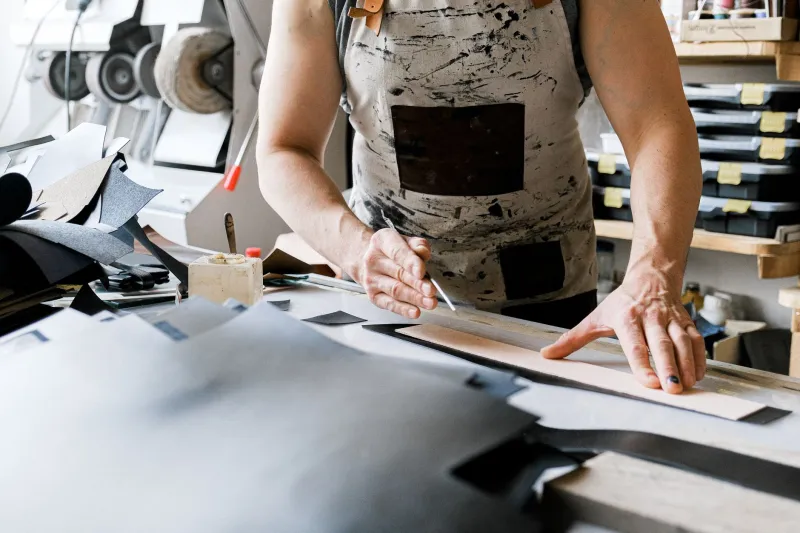
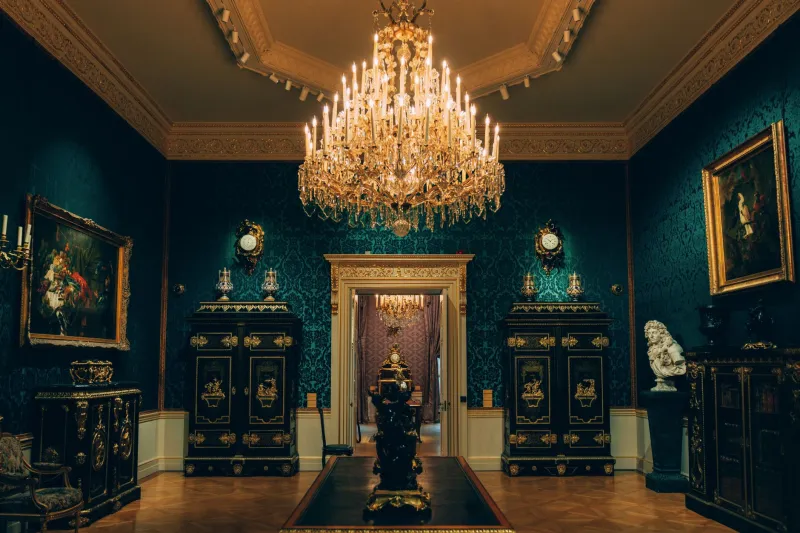
Consider the landscape: perfumers in Dubai working with oud concentrations and molecular distillation techniques that no French house has yet attempted. Furniture artisans in Abu Dhabi sourcing materials — fossilized wood, meteorite inlay, hand-hammered 24-karat gold leaf — that Western production schedules would never accommodate. Textile studios producing hand-woven fabrics of such density and complexity that the lead time on a single commission can extend to eighteen months. Private aviation interior designers whose work has no Western equivalent, not because Western talent is absent, but because Western clients have never thought to ask for what these studios routinely deliver.
This is not emerging luxury. This is mature, disciplined, technically demanding craft — practiced by individuals who have, in many cases, trained in the world's finest workshops before choosing to build something entirely their own in the Emirates.
The American Patron and the Commission Culture
What distinguishes the American collectors now engaging with UAE-based artisans is not simply their wealth — it is their willingness to participate in the creative process at a level that most luxury transactions do not require or permit.
The commission model, which has been central to UAE luxury culture for decades, demands a different kind of client. One who arrives with a vision rather than a catalog preference. One who is prepared to engage in extended dialogue about materials, proportions, cultural references, and the precise emotional register an object should occupy. One who understands that the eighteen-month lead time is not an inconvenience but an integral part of the object's value.
American collectors — particularly those who have spent years acquiring from the established European houses and have grown fluent in the language of luxury — are proving to be exactly this kind of client. They arrive in Dubai and Abu Dhabi not as tourists navigating an unfamiliar market, but as patrons who recognize, often immediately, that they have found a creative latitude unavailable to them elsewhere.
The relationship that develops between these collectors and their UAE-based artisans is, by all accounts, qualitatively different from the transactional dynamics of conventional luxury retail. It is closer, in spirit, to the Renaissance model of patronage: a sustained, reciprocal engagement between a person of means and a person of extraordinary skill, producing objects that neither could have conceived alone.
Beyond the Object: What the Shift Actually Represents
It would be reductive to frame this movement purely in terms of product acquisition. What serious observers recognize is that the migration of American patronage toward UAE-based creators reflects something more fundamental — a recalibration of what luxury is actually for.
For a generation of ultra-wealthy Americans shaped by the logic of brand equity, luxury was a communication tool. The object signaled membership in a recognized hierarchy. Its value was, in part, a function of how many other people understood and acknowledged that hierarchy. The new sensibility operates on an entirely different frequency. The object is not a signal. It is a record — of a specific creative encounter, a particular set of decisions, a relationship between patron and maker that existed nowhere else and produced something that exists nowhere else.
The UAE, with its culture of discretion, its absence of the performative social dynamics that govern luxury consumption in New York or Los Angeles, and its deep tradition of private commission, is structurally suited to support this sensibility. Acquisition here does not happen in flagships or at auction previews. It happens in studios, in private meetings, in conversations that unfold over multiple visits and extended correspondence.
The Provenance of the Future
Provenance, in the most rigorous sense of the word, has never been purely about geography. It has always been about the conditions under which something extraordinary was made possible — the patron's vision, the maker's mastery, the moment in which both converged to produce something that could not have existed otherwise.
By that measure, the UAE is not simply an emerging source of luxury goods. It is becoming one of the defining sites of serious creative patronage in the twenty-first century. The Americans who recognized this early — who arrived before the consensus formed, before the category became legible, before 'made in the UAE' required any explanation — will, in time, be understood to have been among the most prescient collectors of their generation.
For those still deliberating, the window of genuine discovery remains open. But windows of that kind have a habit of closing faster than anyone expects.