Stewardship Over Title: The Quiet Shift From Owning Luxury to Guarding It
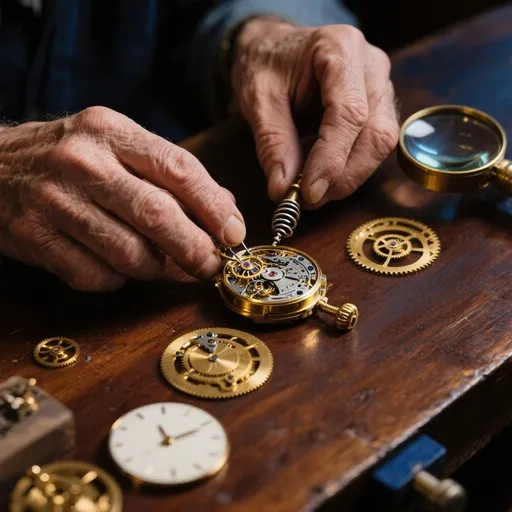
Photo: luxury watchmaker hands craftsmanship atelier dark wood, via images.stockcake.com
For most of the last century, the purchase of a significant luxury asset followed a familiar script. Money changed hands. A certificate was issued. The object belonged to someone, unambiguously and forever.
That script is being rewritten — quietly, clause by clause, in the private offices of Abu Dhabi and Dubai.
When the Deed Becomes the Least Interesting Document
Ask American collectors who have acquired major pieces through Emirati houses in recent years what they signed, and many will describe something closer to a guardianship than a transaction. Purchase agreements increasingly include what industry insiders have begun calling platinum clauses: lifetime stewardship provisions that guarantee the maker's ongoing involvement with an object long after it leaves the showroom.
Under these arrangements, the house retains responsibility for conservation, servicing, authentication, and — critically — the documented chain of custody. Some agreements specify conditions under which the piece must be offered back to the maker before any third-party sale. Others name the object's eventual successor, ensuring that a timepiece or a commissioned sculpture passes to a designated heir with its provenance intact and its care instructions codified.
"The American buyer isn't asking, 'What do I own?'" says one advisor who structures acquisitions for US family offices. "They're asking, 'What happens to this when I'm no longer here to look after it?'"
The American Context: A Reaction to Disposable Provenance
The United States has produced generations of extraordinary collections that were, in a sense, orphaned at the moment of purchase. Estates scattered objects across auction blocks. Certificates were lost. A watch serviced by an unauthorized technician lost its soul on paper, even if it kept time perfectly.
High-net-worth Americans have watched this happen to their parents' collections and their own. The result is a certain weariness with ownership as a legal abstraction. What they crave instead is continuity — the assurance that an object's story will not fracture at the moment of transfer.
The UAE has proven an unexpectedly natural home for this model. Emirati luxury houses, many of them younger and more flexible than their European counterparts, have treated the platinum clause not as a concession but as a product. They built servicing ateliers, in-house registries, and succession documentation into the original offer. The buyer receives not just an object but a standing relationship — one that outlives the transaction itself.
What the Clause Actually Contains
Though each agreement is bespoke, most platinum clauses share a recognizable anatomy:
- Lifetime care covenants, obligating the maker to maintain the piece at no additional cost for as long as the buyer lives.
- Provenance lockboxes, where condition reports, restoration records, and authentication materials are held in trust and travel with the object permanently.
- Right of first conversation, requiring that any future sale begin with the maker, preserving the integrity of the house's registry.
- Succession designations, which allow the buyer to name heirs and embed transfer rituals — often including a formal handover at the house's Dubai or Abu Dhabi premises.
The last provision has taken on particular cultural weight. For American families spread across New York, Dallas, and Palm Beach, the formal succession ceremony in the Emirates has become something of a rite — a moment when an heir formally accepts not just an object but an obligation to it.
Why Continuity Outranks Control
Skeptics will note that these clauses often constrain the buyer. You cannot freely resell. You cannot service the piece wherever you like. You have, in a sense, traded a portion of your sovereignty for the maker's permanence.
That is precisely the point, according to those who sign them. The ultra-wealthy have learned that control is illusory — objects get stolen, misjudged, neglected by heirs who never understood them. What cannot be faked is a house that will still be tending to your acquisition in forty years, with your name in its registry and your intentions on file.
Ownership, in this reframing, is a snapshot. Custody is a film. And the Americans now flying to the Emirates to sign these agreements have decided they would rather star in the longer picture.