The Second Capital: Why America's Most Powerful Individuals Are Establishing Parallel Lives in the UAE
The language we use to describe how the ultra-wealthy relate to geography has quietly undergone a significant revision. For much of the twentieth century, the vocabulary was one of retreat: the estate in the Hamptons, the villa in the South of France, the island in the Caribbean. These were places to withdraw to—sanctuaries from the demands of commercial and civic life, defined precisely by their distance from the centers of power.
That vocabulary no longer fits the reality of how America's most strategically minded high-net-worth individuals are organizing their lives. The concept that has replaced it is not a retreat but a second capital—a fully operational base of influence that runs in parallel with, rather than in opposition to, their primary American presence. And with increasing frequency and conviction, that second capital is being established in the United Arab Emirates.
The Retreat Model and Its Obsolescence
Understanding why the UAE has become the destination of choice requires first understanding what has made the traditional retreat model inadequate. The classic luxury haven—Monaco, Geneva, the Cayman Islands—was designed for a specific purpose: the preservation and protection of wealth from the friction of taxation, regulation, and public scrutiny. These were defensive postures, chosen for what they kept out rather than for what they offered.
For a generation of American ultra-high-net-worth individuals whose wealth is increasingly dynamic—generated through ongoing ventures, global partnerships, and continuously evolving investment strategies rather than inherited and managed passively—the purely defensive haven offers limited value. What they require is not a fortress but a forward operating base: a location that provides favorable conditions not merely for wealth preservation but for wealth creation, relationship development, and the projection of influence across multiple geographies simultaneously.
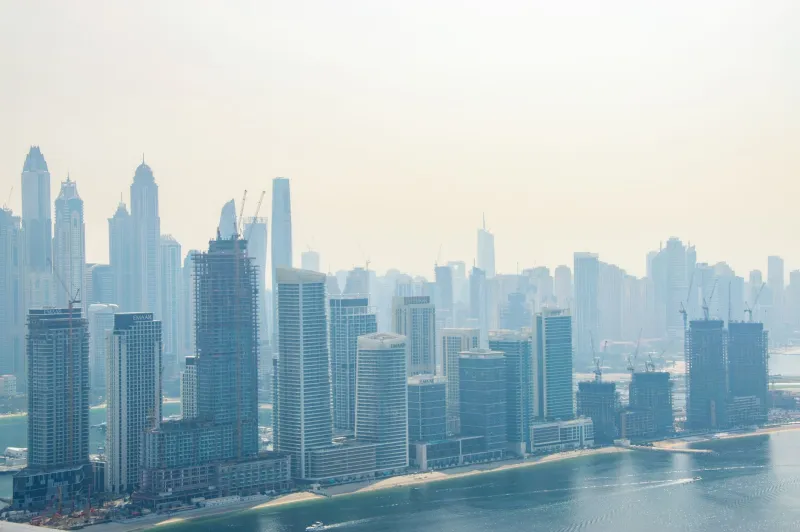
The UAE, and Abu Dhabi and Dubai in particular, has been constructed with precisely this function in mind. It is, by deliberate design, a place where things happen—where deals are structured, introductions are made, and the kind of concentrated elite networking that produces outsized returns on both capital and social investment occurs with unusual density and frequency.
Neutrality as Strategic Asset
One of the UAE's most underappreciated qualities as a second capital is its geopolitical neutrality—a characteristic that has become increasingly valuable as the fractures between major global powers have deepened. In a world where an American presence in certain jurisdictions carries diplomatic freight, and where alignment with one bloc can close doors in another, the UAE occupies a rare position: genuinely respected by East and West, commercially integrated with both, and politically committed to neither in ways that impose costs on those who operate from within its borders.
For the American ultra-wealthy individual whose business interests span continents and whose relationship networks include counterparts from China, India, the Gulf states, Europe, and sub-Saharan Africa, this neutrality is not merely a comfort—it is a competitive advantage. Meetings that would be politically charged in Washington or London occur in Dubai with a naturalness that reflects the Emirates' studied commitment to being a place where commerce and culture transcend geopolitical division.
This is not accidental. The UAE has invested decades in cultivating exactly this reputation, and the infrastructure—legal, financial, cultural, and physical—that supports it is among the most sophisticated in the world.
The Architecture of Parallel Power
Establishing a genuine second capital requires more than a residence and a local bank account. The ultra-wealthy Americans who are building serious parallel presences in the UAE are investing in a full architecture of influence: corporate structures, philanthropic vehicles, cultural patronage, social networks, and the kind of embedded community relationships that take years to cultivate and cannot be replicated by a short-term visitor, however wealthy.
This architecture serves multiple functions simultaneously. It positions its owner advantageously within the UAE's own dynamic economy, which continues to attract talent, capital, and opportunity at a rate that few comparable jurisdictions can match. It provides access to relationship networks that extend across the Gulf Cooperation Council and into markets—South Asia, East Africa, the broader Arab world—that are less accessible from traditional Western power centers. And it creates the kind of local credibility that transforms an outsider with money into a genuine participant in the Emirates' ongoing project of civilizational ambition.
The distinction matters. Visitors, however distinguished, occupy the periphery of any society's real power structures. Those who commit—who build, employ, patronize, and participate over time—earn access to the interior. In the UAE, that interior is extraordinarily rich.
What the UAE Offers That Traditional Havens Cannot
Beyond neutrality and opportunity, the UAE offers something that speaks directly to a particular sensibility among America's most accomplished individuals: the experience of being in a place that takes excellence seriously as a civic value. The Emirates' investment in world-class infrastructure, cultural institutions, educational facilities, and the physical environment of its cities reflects a philosophical commitment to the idea that the built world should aspire to the extraordinary.
For individuals who have spent their professional lives pursuing exactly this standard in their own domains, there is a particular resonance in inhabiting a society that shares the aspiration. The UAE does not apologize for ambition. It celebrates it, institutionalizes it, and creates conditions in which it flourishes.
This cultural alignment, as much as any tax or regulatory consideration, is what has transformed the Emirates from a destination into a home for a growing cohort of American ultra-high-net-worth individuals. They are not arriving to hide. They are arriving to build—and in doing so, they are creating a new geography of American power, one whose center of gravity has shifted decisively toward the Gulf.
The Implications of the Shift
The concentration of American elite presence in the UAE carries implications that extend well beyond the individuals making the move. It reshapes the flow of capital, the direction of philanthropic investment, and the cultural exchanges that define the next generation's understanding of where the world's most interesting work is being done.
For those who have not yet considered the strategic case for a UAE presence, the window in which early movers retain a meaningful advantage remains open—but it will not remain so indefinitely. The second capital is no longer a novelty. Among the truly serious, it is becoming a necessity.