Trust as a Commodity: How America's Ultra-Wealthy Are Building Private Verification Empires for Luxury Goods
There was a time when a monogram, a hallmark, or a house certificate was sufficient. The name on the label carried weight precisely because the institution behind it had spent generations cultivating an unimpeachable reputation. That era has not entirely vanished — but it has been complicated, perhaps irreparably, by the democratization of luxury itself.
When a brand expands its distribution to capture a broader market, it does not merely dilute exclusivity. It introduces systemic vulnerabilities into its own supply chain. And for the individual spending seven, eight, or nine figures on a single acquisition — whether a timepiece, a commission, a gemstone, or a private conveyance — those vulnerabilities are not abstract concerns. They are unacceptable risks.
The response among America's most financially sophisticated individuals has been characteristically decisive: if the institution cannot be trusted unconditionally, build a private architecture of trust that can.
The Erosion of Institutional Certainty
The problem did not emerge overnight. Over the past two decades, the luxury goods sector has undergone a structural transformation that even its most ardent defenders struggle to frame as anything other than a fundamental compromise. Conglomerates absorbed heritage houses. Production volumes increased. Subcontracting arrangements — once unthinkable for brands built on the mythology of the single artisan — became standard practice.
The certificates and authenticity documents that accompany high-value purchases today are, in many cases, produced by the same institutional machinery under scrutiny. A manufacturer's guarantee is, by definition, a self-assessment. For a buyer accustomed to third-party audits in their business dealings, the asymmetry is immediately apparent.
"The wealthiest buyers I work with approach a major acquisition the way they would approach acquiring a company," observes one Dubai-based private acquisition consultant, speaking on background. "They want independent verification. They want the provenance documented by someone who has no financial relationship with the seller. The idea of simply trusting the paperwork that comes in the box — that's not something they're willing to do anymore."
The Anatomy of a Private Audit
What does independent verification look like at the highest levels of the market? The protocols vary considerably depending on the category of acquisition, but certain principles recur with notable consistency.
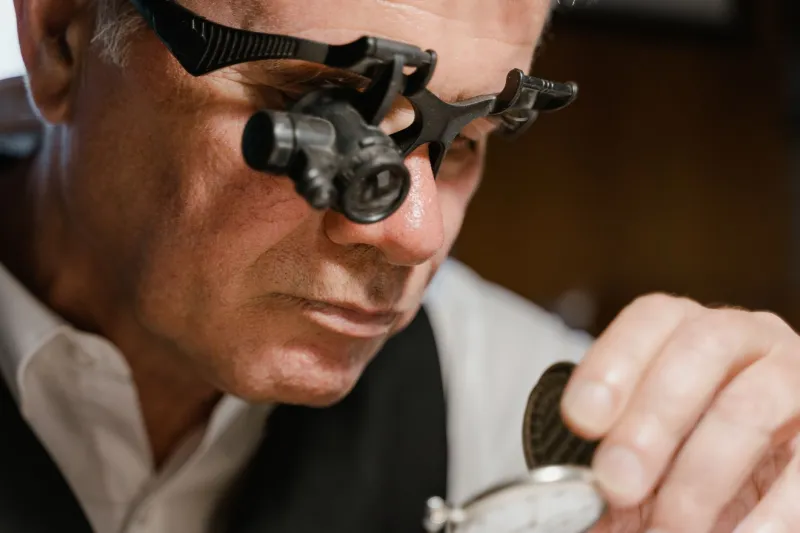
For significant horological purchases — watches in the six-figure range and above — private auditors typically engage specialists with backgrounds in Swiss movement certification, metallurgical analysis, and, increasingly, spectroscopic gemstone verification. The examination is not merely aesthetic. It is forensic. Movement components are assessed against documented production records. Case metals are tested for composition. Provenance documentation is cross-referenced against auction house archives, private dealer records, and, where applicable, estate inventories.
The process for fine jewelry and colored stones is, if anything, more rigorous. Gemmological credentials from the Gemological Institute of America represent a baseline, not a ceiling. Private clients increasingly commission parallel assessments from independent laboratories in Antwerp, Geneva, and Abu Dhabi — not because they distrust any single institution, but because the convergence of multiple expert opinions provides a degree of certainty that no single certificate can replicate.
For bespoke commissions — furniture, automobiles, aircraft interiors, architectural elements — the audit extends into the production process itself. Trusted representatives are embedded at the manufacturing site. Material sourcing is documented from origin. Craftsmen are identified by name and their credentials verified independently.
The UAE as the Hub of Elite Verification
It is not coincidental that many of the most sophisticated private verification operations serving American ultra-high-net-worth clients are headquartered in the UAE. The emirate's position at the intersection of European craftsmanship traditions, Asian manufacturing networks, and Gulf capital flows makes it a uniquely efficient base of operations for specialists who must move fluidly across multiple markets.
There is also a cultural dimension that should not be underestimated. The UAE's luxury ecosystem has long attracted a clientele for whom verification is not a luxury but a prerequisite. The concentration of sovereign wealth, the frequency of genuinely significant acquisitions, and the sophisticated expectation of discretion have created an environment in which private verification services can operate at a level of expertise and confidentiality that would be difficult to replicate elsewhere.
For American clients engaging with the UAE market — whether acquiring locally, commissioning through UAE-based intermediaries, or simply leveraging the emirate's network to verify purchases made elsewhere — the infrastructure is already in place. The question is merely one of access.
The Psychology Beneath the Protocol
It would be tempting to frame private verification purely as a rational response to market conditions. In part, it is. But the psychology at work is more layered than a simple risk-mitigation calculus.
For individuals who have spent careers building institutions, assessing counterparties, and making consequential judgments under uncertainty, the act of verification is not merely protective. It is expressive. It reflects a worldview in which trust is earned through process, not assumed through reputation. It signals, to oneself as much as to any external audience, that one's standards are not subject to negotiation — not even with the most prestigious names in the market.
There is also, it must be acknowledged, a dimension of pleasure in the process itself. The ultra-wealthy individuals who commission the most rigorous private audits are, almost without exception, deeply knowledgeable about the categories in which they acquire. The verification process is not an admission of ignorance. It is an extension of connoisseurship — a way of engaging with the object, its history, and its making at a depth that casual ownership never affords.
When Verification Becomes the Statement
Perhaps the most telling development in this space is the emergence of verification as a social signal in its own right. Among certain circles of American ultra-high-net-worth individuals, the disclosure that an acquisition was subjected to independent private audit carries a distinct weight — not because it implies suspicion of the original vendor, but because it communicates a seriousness of intent that distinguishes the genuine collector from the mere consumer.
To have something properly verified is to have taken it seriously. And in a market saturated with individuals who can afford to buy anything, the ability to demonstrate that one has truly examined what one owns has become its own form of distinction.
The platinum standard, in this context, is not a material designation. It is a disposition — a commitment to knowing, with as much certainty as the discipline of verification allows, exactly what one possesses and why it merits possession.
In an age of mass luxury, that commitment may be the rarest acquisition of all.