Matter Matters: How America's Ultra-Wealthy Are Commissioning Objects Engineered at the Atomic Level
For generations, the conversation around luxury has been conducted in the vocabulary of heritage — the age of a maison, the biography of a craftsman, the lineage of a stone. These were meaningful currencies, and in many respects they remain so. Yet among a particular stratum of America's ultra-wealthy, a more demanding conversation has taken hold. The question being asked is no longer merely who made it or how long it took, but rather: what, precisely, is it made of — and can you prove it is better?
The answer to that question now arrives in the form of spectroscopy reports, crystallographic certificates, and material data sheets that read less like provenance documentation and more like scientific publications. Welcome to the era of compositional luxury, where the atom itself has become the unit of exclusivity.
The Inadequacy of Surface-Level Distinction
The traditional markers of premium goods — hand-finishing, limited production runs, historic workshops — have not disappeared. They have, however, become insufficient for collectors who have spent years studying their categories with genuine rigor. When a client has already owned the finest expression of a conventional benchmark, the natural trajectory is inward: toward the material substrate beneath the surface.
This shift is observable across multiple categories simultaneously. In horology, independent watchmakers working with clients based in cities like New York, Houston, and San Francisco are increasingly fielding requests to replace standard steel components with proprietary alloys derived from aerospace and defense research. Titanium aluminide, originally developed for jet turbine blades, is now appearing in ultra-thin movement bridges commissioned specifically for private collectors. The appeal is not merely technical. It is philosophical: these materials exist because human ingenuity pushed against the absolute limits of what matter can endure.
The Diamond Reimagined From the Inside Out
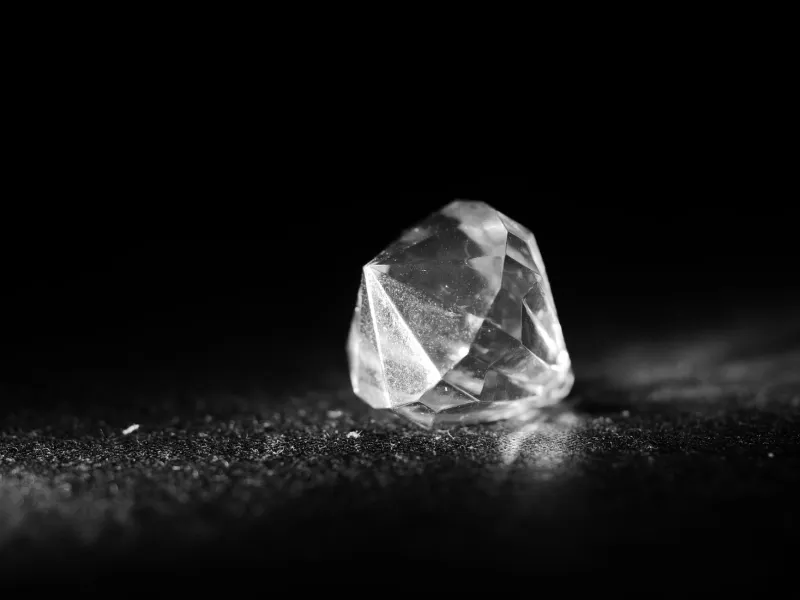
Few categories illustrate the compositional revolution more vividly than gemstones. Lab-grown diamonds — long dismissed by traditionalists as lesser alternatives — have undergone a remarkable reappraisal among the most scientifically literate collectors. The reason is not cost. For individuals whose wealth is measured in nine or ten figures, the price differential is irrelevant. The reason is verified perfection.
A natural diamond, however magnificent, carries the random imperfections of geological formation. A laboratory-grown stone, produced through chemical vapor deposition under precisely controlled conditions, can be commissioned with a specific atomic architecture. Collectors are now working directly with gemological engineers to specify nitrogen vacancy concentrations, isotopic purity ratios, and crystal growth orientations. The result is an object that is, by measurable scientific standards, a more perfect expression of the form than nature itself typically produces.
Verification matters enormously in this space. Certificates from established gemological laboratories are considered a baseline, not a conclusion. Increasingly, serious collectors commission independent atomic force microscopy and Raman spectroscopy analyses — procedures that confirm material composition at the nanoscale — before any acquisition is finalized.
Alloys as Autobiography
Beyond gemstones, the world of bespoke metallurgy has opened into genuinely uncharted territory. Several private foundries, operating quietly in Europe and the UAE, now accept commissions for objects — writing instruments, small sculptures, functional tableware — crafted from alloys that do not exist in commercial circulation. These materials are developed in collaboration with materials scientists, sometimes drawing on research originally conducted for medical implants or deep-sea instrumentation.
The UAE has become a particularly significant node in this ecosystem. The Emirates' positioning as a nexus between Eastern manufacturing excellence and Western design sensibility, combined with its concentration of engineering talent drawn from global aerospace and energy industries, has created conditions uniquely favorable to this kind of commission work. Several American collectors have established ongoing relationships with UAE-based atelier-laboratories that handle both the metallurgical development and the final fabrication of bespoke objects — a continuity that ensures the material story remains coherent from conception to completion.
The Documentation of Superiority
What distinguishes this generation of material-focused collectors from earlier enthusiasts of fine craftsmanship is their insistence on documentation that is legible to scientific scrutiny. An object may be extraordinarily beautiful, but beauty alone no longer closes the transaction. The collector wants a material data sheet. They want independent third-party testing. They want to understand the yield strength, the thermal conductivity, the corrosion resistance profile of the metal they are about to commission.
This is not pedantry. It reflects a broader epistemological shift among ultra-high-net-worth Americans who have built their wealth through industries — technology, finance, biomedical research, energy — that demand precisely this kind of rigorous verification. They are applying to luxury acquisition the same intellectual standards they apply to everything else of consequence in their lives.
The result is an object class that is, in a very literal sense, composed of superior matter. Not superior by tradition or reputation, but superior by measurement.
When Science Becomes the New Signature
There is a social dimension to this phenomenon that deserves acknowledgment. Within the circles where these objects circulate, the ability to discuss one's commission in technical terms has become its own form of fluency. Understanding the difference between a Type IIa diamond and a standard gem-quality stone, or being able to speak credibly about the grain boundary behavior of a custom titanium alloy, signals a depth of engagement that no amount of wealth alone can purchase.
This is, in a sense, the ultimate democratization-proof luxury. Counterfeiting an object whose superiority is verified at the atomic level is not merely difficult — it is essentially impossible with current technology. The scientific documentation becomes, simultaneously, the provenance and the authentication.
For America's most discerning collectors, that combination — material truth confirmed by independent science — represents a standard of confidence that no heritage label, however storied, can fully replicate. The platinum standard, it turns out, is not a metaphor. It is a specification.